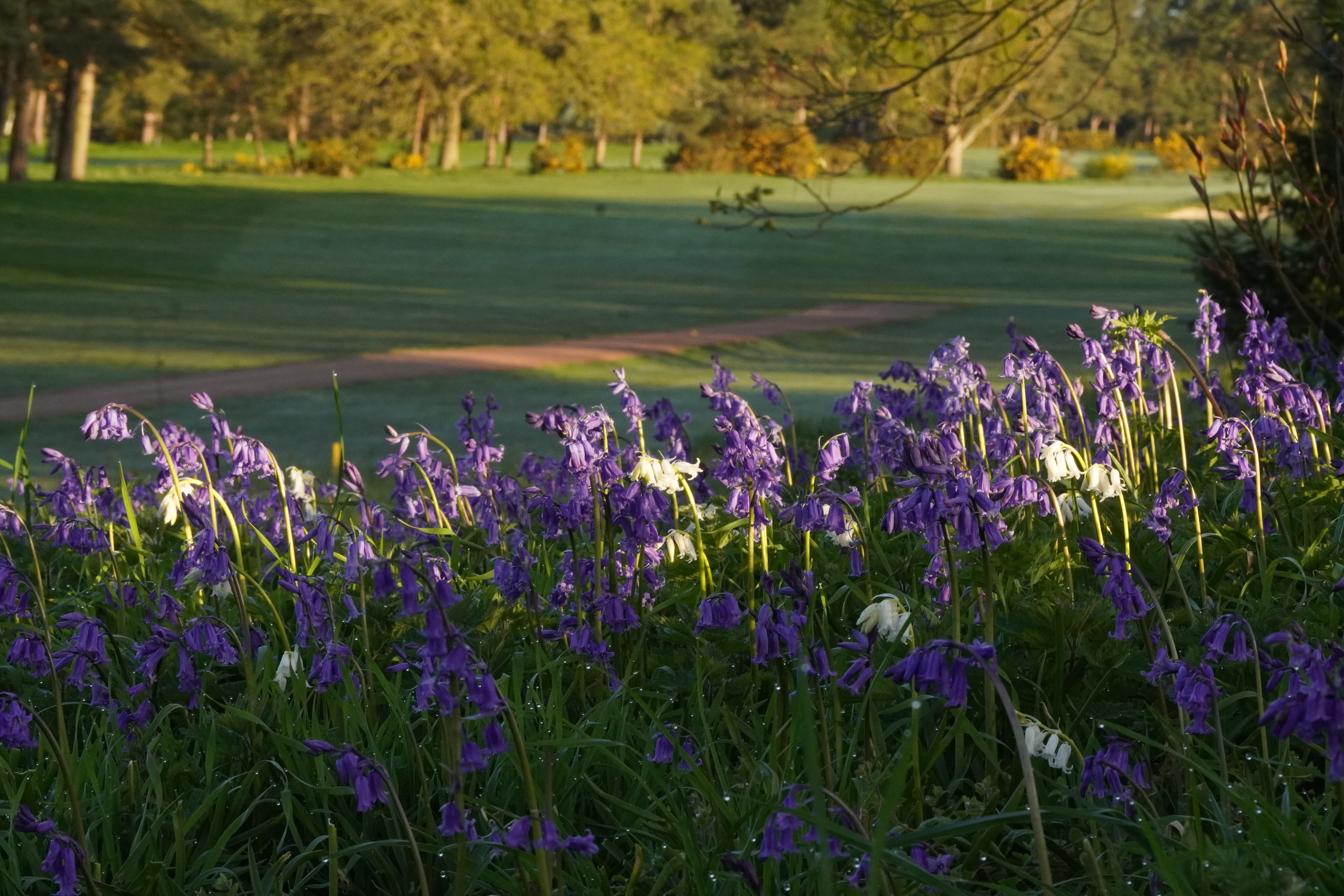
I went onto the estate this morning out to have a look at some of the spring flowers around the courses. Some of the most striking are the March Marigolds which grow in the marshy areas near the 3rd and 9th on the Blue. There seems to be a particularly good display this year
Marsh Marigold Caltha palustris [9th Blue]
Between the 6th and 16th on the Green course I came across Meadow Saxifrage. I can't believe how I have missed this in previous years and there are lots of obvious clusters of it here. Saxifrages are more commonly known as mountain species, but Meadow Saxifrage grows on unimproved grassland in the UK. There is one other Saxifrage that grows at Frilford in a more alpine environment on the main card park wall - Rue-leaved Saxifrage. This is not so easy to spot as it is a lot smaller.
A more conspicuous alpine plant, also growing of the wall of the car park is Fairy Foxgloves.
Fairy Foxglove Erinus alpinus [Car park]
One rather delicate flower that is all over the marshy areas of the course at this time of year is Cuckoo Flower, also known as Lady's Smock or Mayflower. This patch was on the 18th on the Red.
Glorious day today. Went out for a walk this morning and played the back nine of the Red this evening.
The highlight was watching a Water Vole beside the stream at the back of the 3rd Blue first thing. Water Voles have declined by 95% in the UK since the 1970s, due to habitat loss and predation by Mink. They need slow-flowing streams like the one on the Blue course and typically range over a stretch of about 120 metres. I have seen one a couple of times before, but only very briefly. This one seemed oblivious to my presence.
Water Vole [3rd Blue]
Here are the video highlights. These mostly contain eating - not surprising given that a Water Vole needs to consume 80% of its body weight each day. I've tried this a few times myself, and it's not easy to do - certainly not day after day eating grass.
On the 18th of the Red I came across this flower. Whilst it looks like the Primroses nearby - Primrose flowers only grow singly. It is either an Oxlip, which is a very scarce plant, or a False Oxlip, which is a cross between a Cowslip and a Primrose and the more likely.
False Oxlip Primula vulgaris x veris [18th Red]
Easier to identify are the Fairy Foxgloves which brighten up the car park.
Lots of plants starting to come into flower on the course. The first orchids are in bud in on the 4th Green and should be out in the next couple of days. The Fairy Foxgloves are also in flower in the car park. No relation to the larger Digitalis foxgloves, these are native the mountains of south west Europe, but have become naturalised in the UK, growing on limestone walls such as ours.
Fairy Foxglove Erinus alpinus [Car Park]
Another naturalised native of Europe is the Dusky Crane's-bill, with its unusually dark flowers. This one was by the footpath between the 1st and 18th on the Blue.