| Goldfinch (5th Red) |
| Stock Doves (Reservoir) |
| Linnet [12th Blue] |
| Goldfinch (5th Red) |
| Stock Doves (Reservoir) |
| Linnet [12th Blue] |
Played a couple of times on the Blue course this weekend and had a walk around the Red course. It itsnoticeable that the rough is getting longer. One of the more attractive plants that you may come across if your driving is errant is the Musk Mallow. There are plenty on the Red course. This one was behind the 4th.
| Musk Mallow [4th Red] |
I have looked hard, but seen very few snakes around the estate over the last three or four years. Last week I saw a very small grass snake next to the 13th tee on the Red but was unable to get a photo before it slithered off. On the Blue course however I came across this Grass Snake in front of the 2nd tee. It had captured a frog, and unless I have badly misread the situation, the frog was having a pretty bad time.
Snakes are able to dislocate their jaws in order to swallow prey that is wider than their mouth. Even with this trick this snake looked to have bitten off more than it could swallow.
| Grass Snake [2nd Blue] |
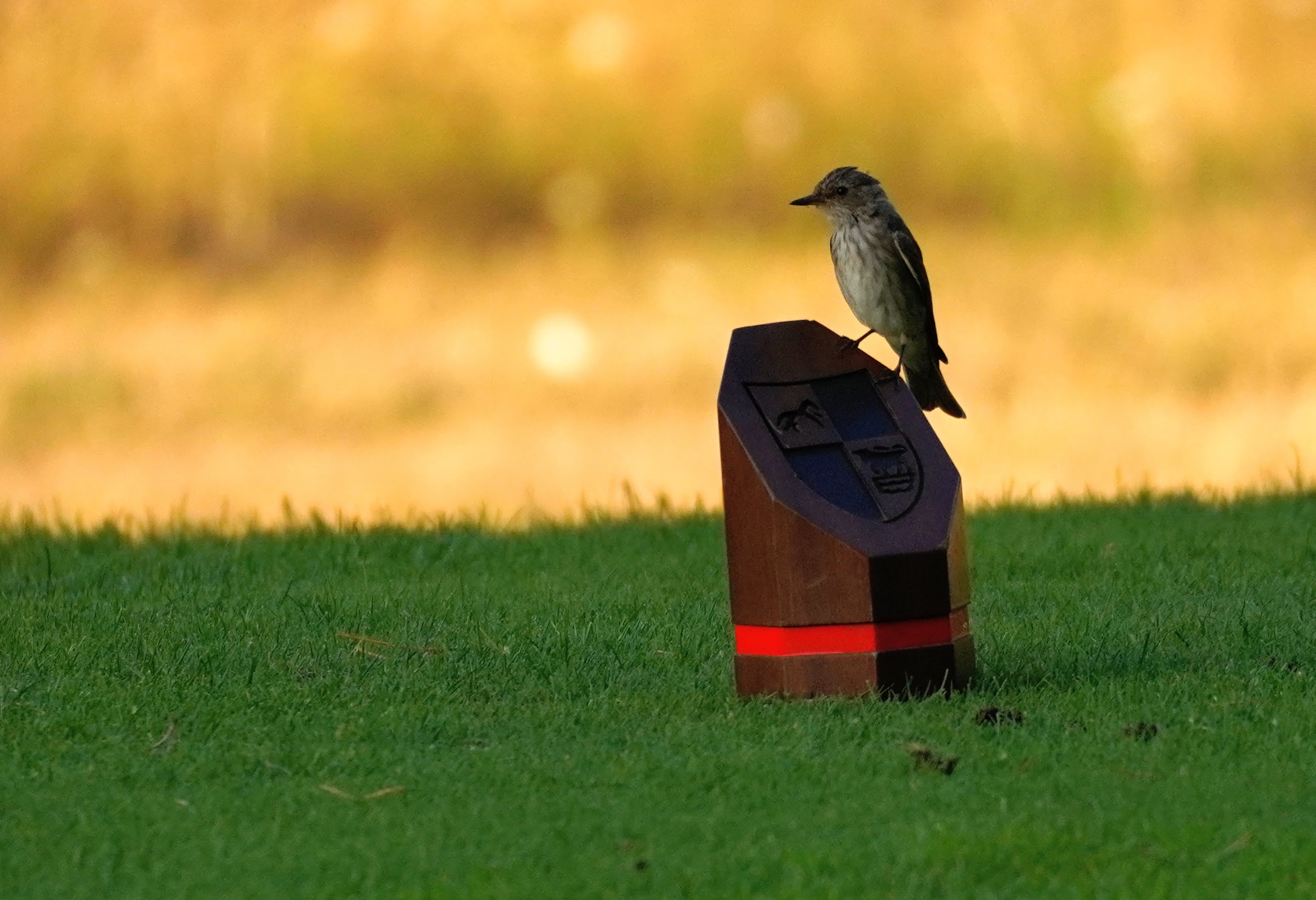
There were a pair of Spotted Flycathers around the 3rd and 9th on the Blue.
| Spotted Flycatcher [8th Blue] |
After the excitement of hearing and occasionally seeing a Lesser Whitethroat on the 5th Red in May I came across a pair of Common Whitethroats today, clearly nesting close by. These are a little less secretive than the Lesser Whitethroat and I was able to get a couple of photos. The male is in the top photo and is a little more colourful than the female (bottom photo)
| Whitethroats [5th Red] |
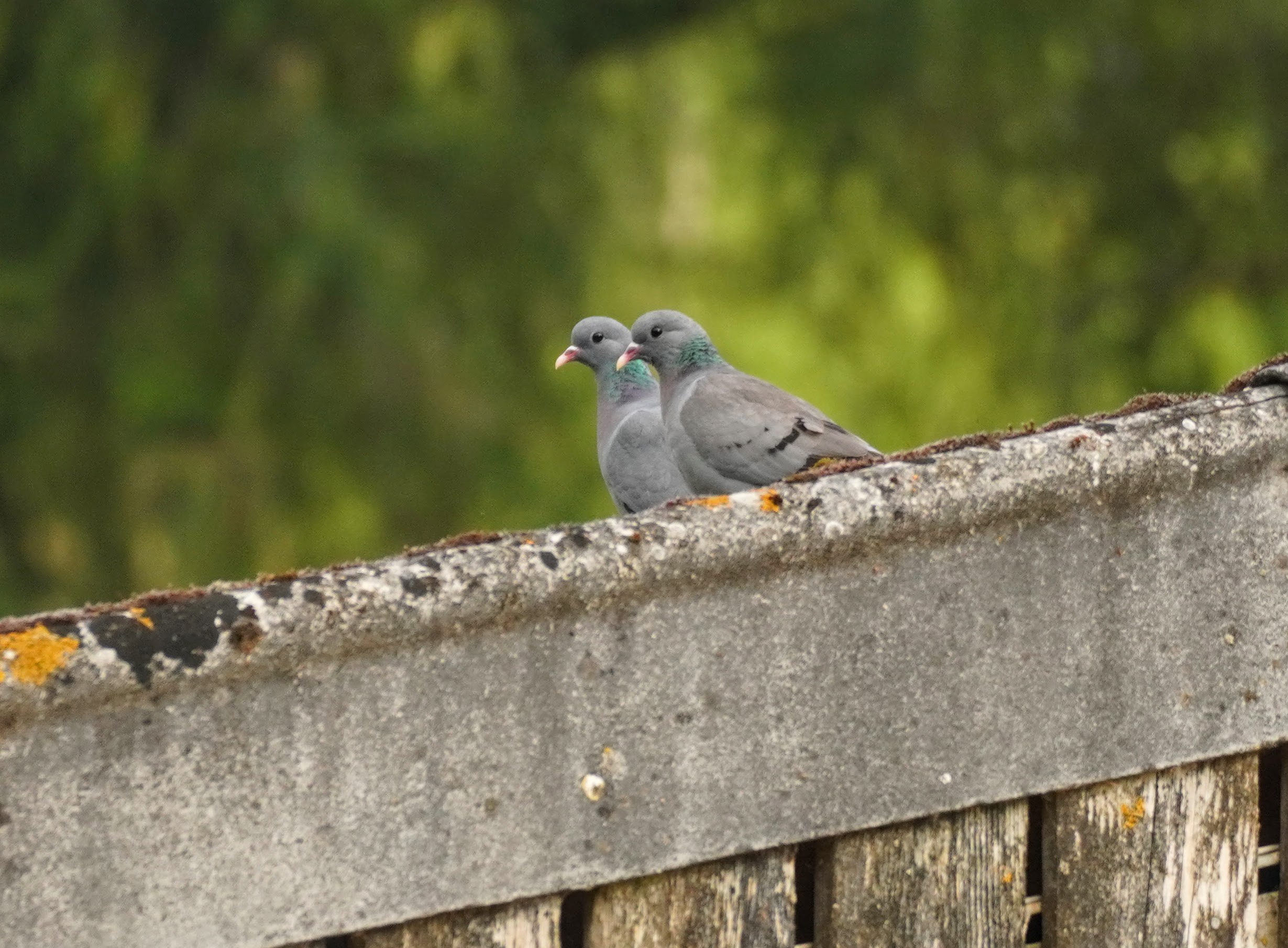
It is good to see that the Stock Doves are still nesting somewhere near the greenkeepers' shed on the 16th Blue. This pair was on the roof today.
| Stock Dovers [16th Blue] |
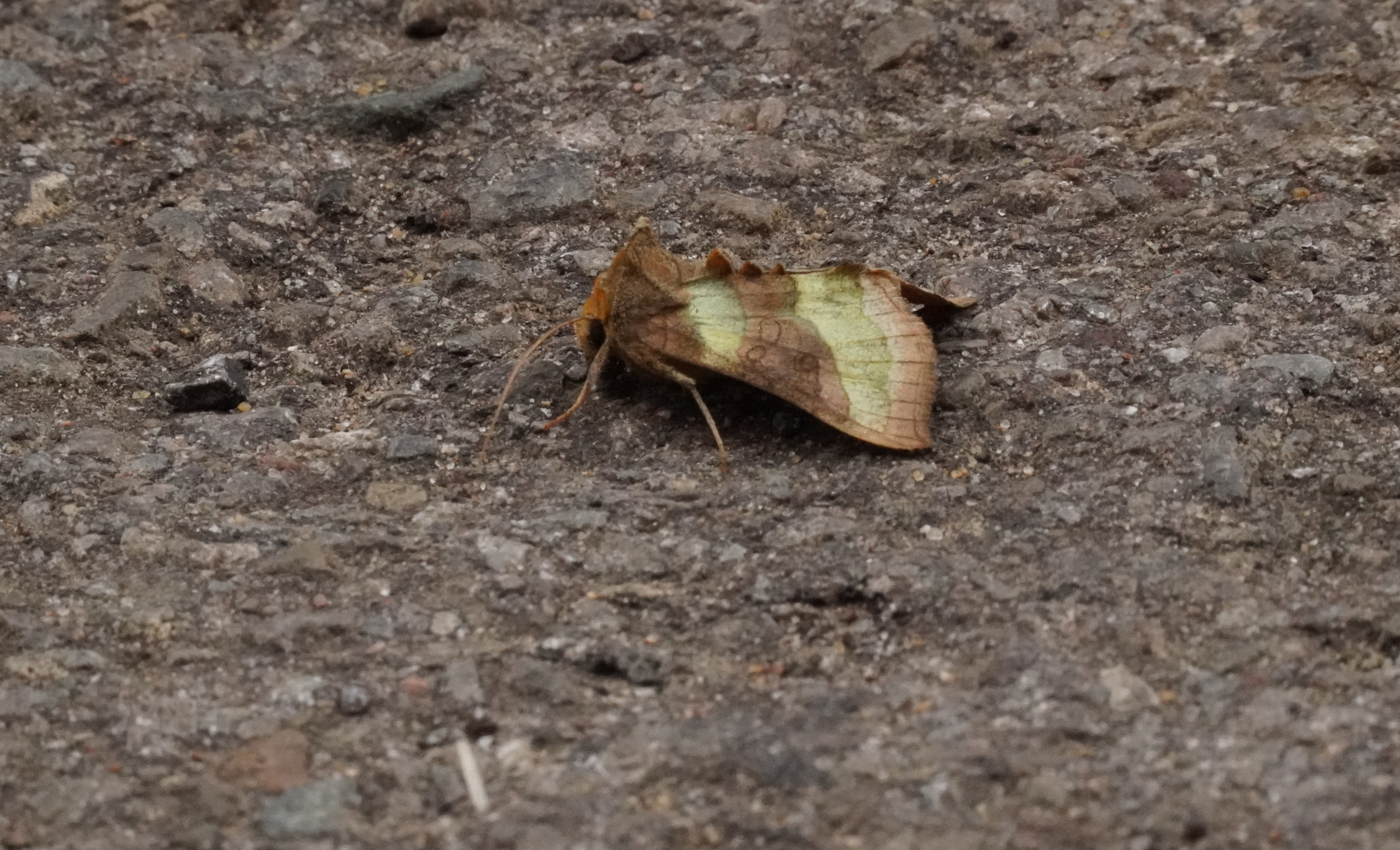
| Burnished Brass Diachrysia chrysitis [car park] |
Had a walk around the estate today. This year I have heard a Lesser Whitethroat on the course for the first time in a few years. Its territory seems to be centred around the footpath to the left of the 5th on the Red course. They are easy to hear, but virtually impossible to see or photograph as they generally stay hidden in bushes. In several hours of trying, this is the best picture that I managed to get.
| Lesser Whitethroat [5th Red] |
There also Linnets nesting in the gorse in this area. They are a little less secretive and there are lots of them.
| Linnet [5th Red] |
A little lower down the footpath you can find a patch of Heath Dog Violets, one of Frilford's speciality flowers. They are a bit bluer than the more common violets and have a yellow spur.
| Heath Dog Violet Viola canina [4th Red] |
Cinnabar moths are quite common on the courses at this time of year. They have distinctive red colouring and fly during the day. Later in the year, look out for their black and yellow caterpillars. This one was on the grass on the 1st Blue.
| Cinnabar Tyria jacobaeae [1st Blue] |
Also on the 1st Blue I came across this freshwater mussel shell. I suspect that this may have been eaten by an otter and left on the fairway.
| Freshwater Mussel [1st Blue] |
I had a few holes and a few walks around the course over the last week or so. It was nice to see a few ducks on the reservoir, particularly on Monday when it offered a bit of shelter from the wind. There were six Gadwall (5 males and 1 female), which is the most that I have seen around Frilford, as well as around a dozen Tufted Ducks and some Coot.
| Gadwall [Reservoir] |
| Gadwall [Reservoir] |
| Tufted Ducks [Reservoir] |
| Little Grebe [Reservoir] |
| Linnets [9th Green] |
| Redpoll [15th Red] |
Popped out a few times over the week for nine holes and a stroll. It is fairly quiet nature-wise. I did come across this tiny frog hopping across the 3rd fairway on the Green course - one of the few areas that generally stays fairly moist.
| Common Frog [3rd Green] |
| Spotted Flycatcher [10th Blue] |
| Linnet [Reservoir] |
A couple of weeks ago as I walked through the scrubby area between the 14th and 15th Red I heard a bird song that I didn't quite recognise, but assumed that it must have been a Blackcap. I heard the same again this morning, but managed to track down the bird which turned out to be a Garden Warbler. It is the first time that I have seen one at Frilford. This individual was quite obliging and sang pretty much continuously for half an hour. Garden Warblers are the same size as a Blackcap and, other than the song, have no real distinguishing features. My bird book describes them, rather harshly, as 'nondescript and featureless'. It was nice to see one nevertheless.
| Garden Warbler [15th Red] |
It is interesting to compare the song to this Blackcap that I filmed on the 9th Blue a couple of weeks ago. The Blackcap is a little more melodic with shorter phrases.
There were a lot of Linnets on the 13th-15th Red. They nest in the Gorse bushes.
| Linnet [13th Red] |
| Common Twayblade Neottia ovata [4th Green] |
Another crisp clear morning, with plenty of different birds singing. Blackbirds are one of the most common birds around the estate and are singing all over the courses at the moment. Their song does not quite have the musical quality or clarity of a Song Thrush. I've also only noticed this year that they seem to start singing slightly later than thrushes - perhaps for fear of being shown up. This one was on the 8th, you can also hear a Wren in the background.
There are lots of warblers singing around the course. I heard at least three Willow Warblers and numerous Blackcaps and Chiffchaffs. This clip is a Chiffchaff on the 6th, but you can also hear a Blackcap singing in the background.
I saw and heard a Lesser Whitethroat on the left of the 2nd on the Blue, towards the end of the fairway. They are rather shy birds and difficult to spot, and have a white throat with uniform grey upper-parts and dark legs. I heard one in the same spot last year, so hopefully it should be around for the summer.
| Lesser Whitethroat [2nd Blue] |
Like most warblers, Lesser Whitethroats have a distinctive song, in their case ending with a bit of trill - diggadiggadiggadigga, which you can hear in this brief clip:
There are lots of Linnets singing around the course all over the Blue and Red - this one was on the 5th Red:
The Reed Buntings are also still around the 3rd and 4th on the Blue:
| Reed Bunting [3rd Blue] |
| Brown Hare [15th Blue] |
Had a walk around the Red and Blue courses this morning. A few more plants to tick off for the year, although I'm learning that identification of a lot of species is far from straightforward. Bluebells are one flower that is fairly easy and a few are appearing on the left of the 13th on the Red.
| Bluebell Hyacinthoides non-scripta [13th Red] |
This small shrub grows in some quantity on the the left of the 13th on the Red and I think that they are some sort of currant. I will go for Red Currant for the moment and will hopefully get further clues when they fruit.
| Red Currant Ribes rubrum [13th Red] |
I think that this is a Dove's Foot Cranesbill on the left of the 15th on the Blue:
| Doves-foot Cranesbill Geranium molle [15th Blue] |
I think that this is a Wood Forget-me-not on the left of the 13th Red.
| Wood Forget-me-not Myosotis sylvatica [13th Red] |
I think that this is Slender Speedwell on the 3rd on the Red.
| Slender Speedwell Veronica filiformis [3rd Red] |
This is definitely Field Mouse-ear - with the 15th on the Red in the background.
| Field Mouse-ear Cerastium arvense [15th Red] |
Not too much around bird-wise. A few more Swallows, four Tufted Duck on the pond by the 4th tee on the Blue and lots of Linnets in the gorse on the 5th and 15th Red, where I think that they nest.
| Tufted Duck [4th Blue] |
| Linnet [5th Red] |
| Song Thrush [6th Blue] |