I walked around the Red course this morning. It was good to hear lots of birdsong. The warblers were particularly vocal. At the side of the 5th hole I heard Lesser Whitethroat, Garden Warblers and Blackcap. Sadly the Lesser Whitethroat was elusive, but it was good to see a pair of Garden Warblers. I usually see these to the right of the 13th hole but this pair seem to be nesting on the 5th.
Garden Warblers [5th Red]
Blackcap [5th Red]
Plenty of plants in the light rough at the moment. Sheep's Sorrel gives the rusty colour on much of the Red and Green courses.
Sheep's Sorrell Rumex acetosella [12th Red]
Field Mouse-Ear also grows on the Red and Green courses and is very common at Frilford, but quite rare elsewhere.
I had a walk in the sunshine this morning. In July and August there are usually a lot of juvenile birds around the estate. They have typically fledged by now and are learning to feed, often in a family party. The noisiest family parties are definitely Green Woodpeckers. There are lots of them around the courses at the moment. This juvenile was one of several calling very loudly for several minutes to the left of the 3rd Blue.
Green Woodpecker [3rd Blue]
When I took a detour from the 3rd tee to investigate the reason for the commotion became clear - you can see a nearby Buzzard in the background of the next picture.
Not far away, this juvenile Grey Heron was behind the 4th tee and the juvenile Blackcap was one of several to the left of the 5th Red.
Had a quick walk around the Blue and Red courses in the sunshine early this morning. Beside the 10th tee on the Red I came across half a dozen or so Soapwort plants. I usually see Soapwort on the 14th/15th of the Red, this is the first time that I have come across them on the 10th. Their leaves/roots, when boiled, lather up and produce a mild detergent - hence the name.
Soapwort Saponaria officinalis [10th Red]
There are a lot of young birds around the course at the moment - particularly Willow Warblers and Blackcaps. This young Blackcap was in the Wood between the 16th and 17th Blue.
Blackcap [16th Blue]
The Grey Heron was next to the pond on the 1st Blue this morning and this rather tame young Roe Deer was in the woods behind the 6th Blue.
Beautiful sunny still morning today. I had a walk around parts of the Blue and Red course. An Egyptian Goose stopped off at the reservoir, a new addition to the Frilford list.
Egyptian Goose [Reservoir]
As its name suggests, the Egyptian Goose is an introduced species, first recorded in England in 1678, but is now fairly common, particularly in urban parks.
Trickier to spot, but easier to hear, there are still plenty of warblers singing and feeding. This Blackcap is usually singing near the bridge near the 1st Blue, although is tricky to spot.
Blackcap [1st Blue]
Also easier to hear that see are the various Whitethroats nesting around the estate. This one was skulking in the gorse to the left of the 5th Red.
Whitethroat [5th Red]
Willow Warblers seem to be the opposite. I have scarcely heard one this year, but always seem to find a lot feeding. This one is fairly regular in the gorse between the 4th and 5th Red.
Willow Warbler [4th Red]
Various insects around. I think that this is a Hairy Dragonfly near the 13th tee Blue, well camouflaged amidst the undergrowth. The Emperor dragonfly was rather more conspicuous with early-morning due on its large wings. The Common Blue Damselfly was near the 3rd on the Red, but they are fairly common on the Blue and Red course
Hairy Dragonfly Brachytron pratense [13th Blue]
Emperor Dragonfly Anax imperator [1st Blue]
Common Blue Damselfly Enallagma cyathigerum [3rd Red]
This Large Skipper looks more like a moth, but is actually a butterfly. This is a male - sitting on a leaf waiting for a female on the 4th Red.
Large Skipper Ochlodes sylvanus [4th Red]
The Southern Marsh Orchids are in full bloom just short of the pond on the 9th Red. There are also some Common Spotted here as well and Early Marsh Orchids as well if you have time to search.
A couple of weeks ago as I walked through the scrubby area between the 14th and 15th Red I heard a bird song that I didn't quite recognise, but assumed that it must have been a Blackcap. I heard the same again this morning, but managed to track down the bird which turned out to be a Garden Warbler. It is the first time that I have seen one at Frilford. This individual was quite obliging and sang pretty much continuously for half an hour. Garden Warblers are the same size as a Blackcap and, other than the song, have no real distinguishing features. My bird book describes them, rather harshly, as 'nondescript and featureless'. It was nice to see one nevertheless.
Garden Warbler [15th Red]
It is interesting to compare the song to this Blackcap that I filmed on the 9th Blue a couple of weeks ago. The Blackcap is a little more melodic with shorter phrases.
There were a lot of Linnets on the 13th-15th Red. They nest in the Gorse bushes.
Linnet [13th Red]
Look out for Common Twayblade in Two Pine Fen. It is the second of Frilford's orchids to flower and though not as colourful as the others they are very numerous.
Beautiful morning on Good Friday. I took the chance to walk the perimeter of the Red and Blue courses in particular to have a look at the spring flowers. It was apt that one of the flowers in evidence, for those prepared to search, is Moschatel, which is also known as the Good Friday Plant. It grows in most of the shady wooded areas on the course, but its green flowers are hard to spot.
Moschatel Adoxa moschatellina [18th Green]
More conspicuous in the wood behind the 6th Blue is Wood Sorrel, which is a delicate white flower with distinctive clover-like leaves.
Wood Sorrel Oxalis acetosella [6th Blue]
The wood to the left of the 13th Red is full of Yellow Archangel which has distinctive variagated foliage and yellow flowers.
Yellow Archangel Lamium galeobdolon [13th Red]
Other flowers include Honesty a colourful roadside weed and Greater Periwinkle on the left of the 17th Green.
Honesty [Doghouse range]
Greater Periwinkle Vinca major [17th Green]
Brimstones are usually the first butterfly to appear in spring. This one had settled on a Dandelion at the back of the 9th on the Blue.
Common Brimstone Gonepteryx rhamni [9th Blue]
In the long grass to the left of the 3rd Blue I came across this Ruby Tiger moth.
Ruby Tiger Phragmatobia fuliginosa [3rd Blue]
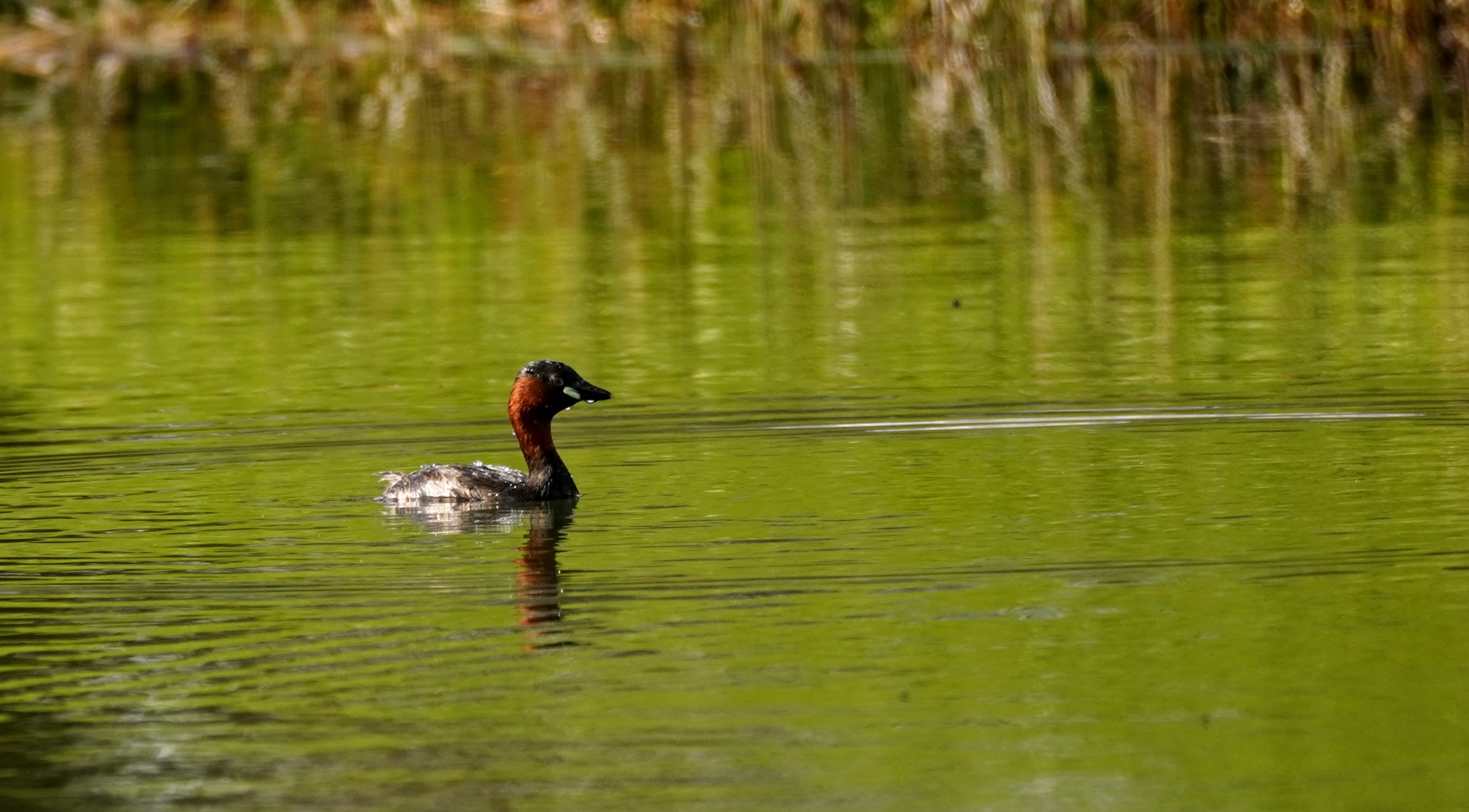
A Little Grebe was on the pond nearby. I watched it briefly before it dived under the water and must have swum to the undergrowth as I couldn't spot it again.
Little Grebe [3rd Blue]
This Blackcap was singing in the trees above the bridge between the Red and Blue courses.
As well as the constant surprises as to what you see around the golf course, it is also interesting to note from time to time what you don't see. Some birds that are common elsewhere are only occasional visitors to the golf course. House Sparrows are a good example. The only place that I have seen them on the estate this year is around the edge of the reservoir and in the hedge next to the driving range. These two females were part of a flock of half a dozen birds in the bushes on the far left of the driving range.
House Sparrows [Driving range]
A male Blackcap also passed through this area.
Blackcap [Driving range]
In somewhat better light, this Treecreeper was next to the path between the 16th and 17th on the Blue.
Lots of warblers flitting through the leaves of the small trees and shrubs of the Blue course this morning.
Blackcap [4th Blue]
Chiffchaff [3rd Blue]
Willow Warbler [4th Blue]
This Red Admiral was warming up on the left of the 5th Blue.
Red Admiral Vanessa atalanta [5th Blue]
Whilst this Ringlet was drying out from the early morning due on the 3rd Blue. With their underwing visible, you can see where the name comes from.
Ringlet Aphantopus hyperantus [3rd Blue]
A good crop of Wild Raspberries are starting to ripen on the left of the 14th Blue - tasted very sweet.
Raspberry Rubus idaeus [14th Blue]
In the wood on the Blue I found some Marsh Cudweed, which is actually a lot more common nationally than the Common Cudweed that grows in much of the rough around the estate and which, despite its name, is on the Oxfordshire Rare Plants Register.