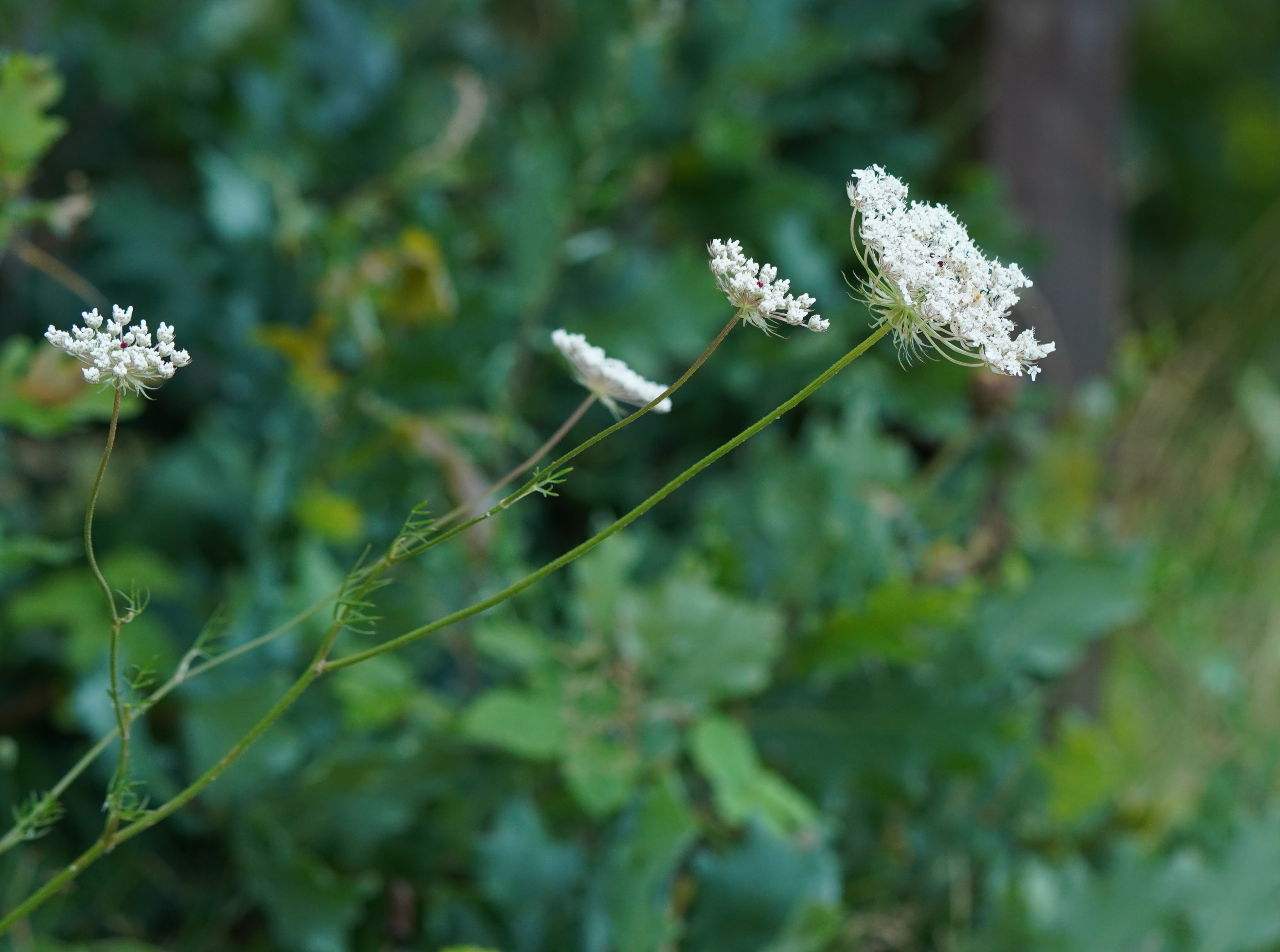
Prime time of year for flowers. Some of the most spectacular on the course at the moment are the Southern Marsh Orchids between the 8th and 11th on the Blue. These are around 50cm tall and very visible from the fairway on the 11th - there are actually a couple of clusters. It is unusual for them to have spotted leaves - possibly due to hybridising with Common Spotted.
 |
| Southern Marsh Orchid Dactylorhiza praetermissa [11th Blue] |
There is another type of orchid nearby, the Pyramidal Orchid. Somewhat smaller and just coming into flower. You will see lots of these if you visit Goring and Streatley Golf Club.
 |
| Pyramidal Orchid Anacamptis pyramidalis [11th Blue] |
On the third Blue there are lots of Common Spotted Orchid, including this unusual pure white one.
 |
| Common Spotted Orchid Dactylorhiza fuchsii [3rd Blue] |
Also on the 3rd Blue there is a lot of Tufted Vetch.
 |
| Tufted Vetch Vicia cracca [3rd Blue] |
Here's a close up of the moth in the background of the previous photo, which I think is a Narrow-bordered Five-spot Burnet.
 |
| Narrow-bordered Five-spot Burnet Zygaena Ionicerae [3rd Blue] |
A couple of quite similar flowers growing near the 1st green on the Red. Weld is a tall plant growing up to 6 feet high if it can avoid the mower. Wild Mignonette is shorter and bushier.
 |
| Weld Reseda luteola [1st Red] |
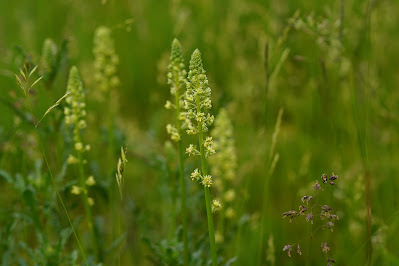 |
| Wild Mignonette Reseda lutea [1st Red] |
We are also nearing peak clover season. White Clover is the most common and is the one that conceals your golf ball even when it's only just off the fairway.
 |
| White Clover Trifolium repens [15th Blue] |
Red Clover is also fairly common in wet areas. This one was in the fen on the 3rd Blue.
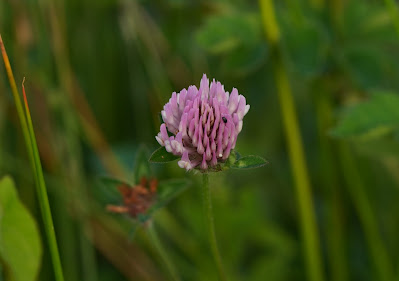 |
| Red Clover Trifolium pratense [3rd Blue] |
If you look closely, you may also spot Knotted clover, which grows on the 12th on the Blue.
 |
| Knotted Clover Trifolium striatum [12th Blue] |
Hare's-foot Clover is also common on the 11th of the Blue and the Doghouse range in particular.
 |
| Hare's-foot Clover Trifolium arvense [Doghouse range] |
From hare's foot to the animal itself. This one was on the 2nd Blue.
 |
| Brown Hare [2nd Blue] |
The Great-crested Grebe is still on the reservoir. A Lesser Black-backed Gull also stopped by earlier in the week.
 |
| Lesser Black-backed Gull [Reservoir] |
A Buzzard also flew over this evening.
 |
| Buzzard [Reservoir] |