I had a brief walk around the Blue and Red courses this morning. I think that there is one pair of Egyptian Geese left after the territorial dispute and they have raised three chicks. They are usually found around the pond on the 3rd.
Egyptian Geese [3rd Blue]
There are plenty of other young birds around the course at the moment, including this Dunnock on the 5th Red.
Dunnock [5th Red]
Field Pansies are quite common, but are still one of my favourite Frilford flowers. They grow on the Blue course, including in the car park at the Tubney range, but are quite small and inconspicuous.
Field Pansy Viola arvensis [15th Blue]
I am often amazed and amused at where I find golf balls in my visits to the more remote areas of the three courses. This ball was embedded in the branch of the tree to the left of the 5th hole on the Blue.
I walked around the front nine of the Blue early this morning. As you can see from the photo, the fairways were pretty wet after the rain of the last few days. There wasn't too much about, although I did come across a new plant for my Frilford list. Lesser Swine-cress grows around the 3rd, although it is not a plant of great beauty.
Lesser Swine-cress Coronopus didymus [3rd Blue]
Rather prettier is the Field Pansy which is common all over the Blue course. This one was also on the 3rd
Field Pansy Viola arvensis [3rd Blue]
I also called in briefly at the Doghouse practice ground, which is covered in Knotted Clover at this time of year.
Knotted Clover Trifolium striatum [Doghouse Practice Ground]
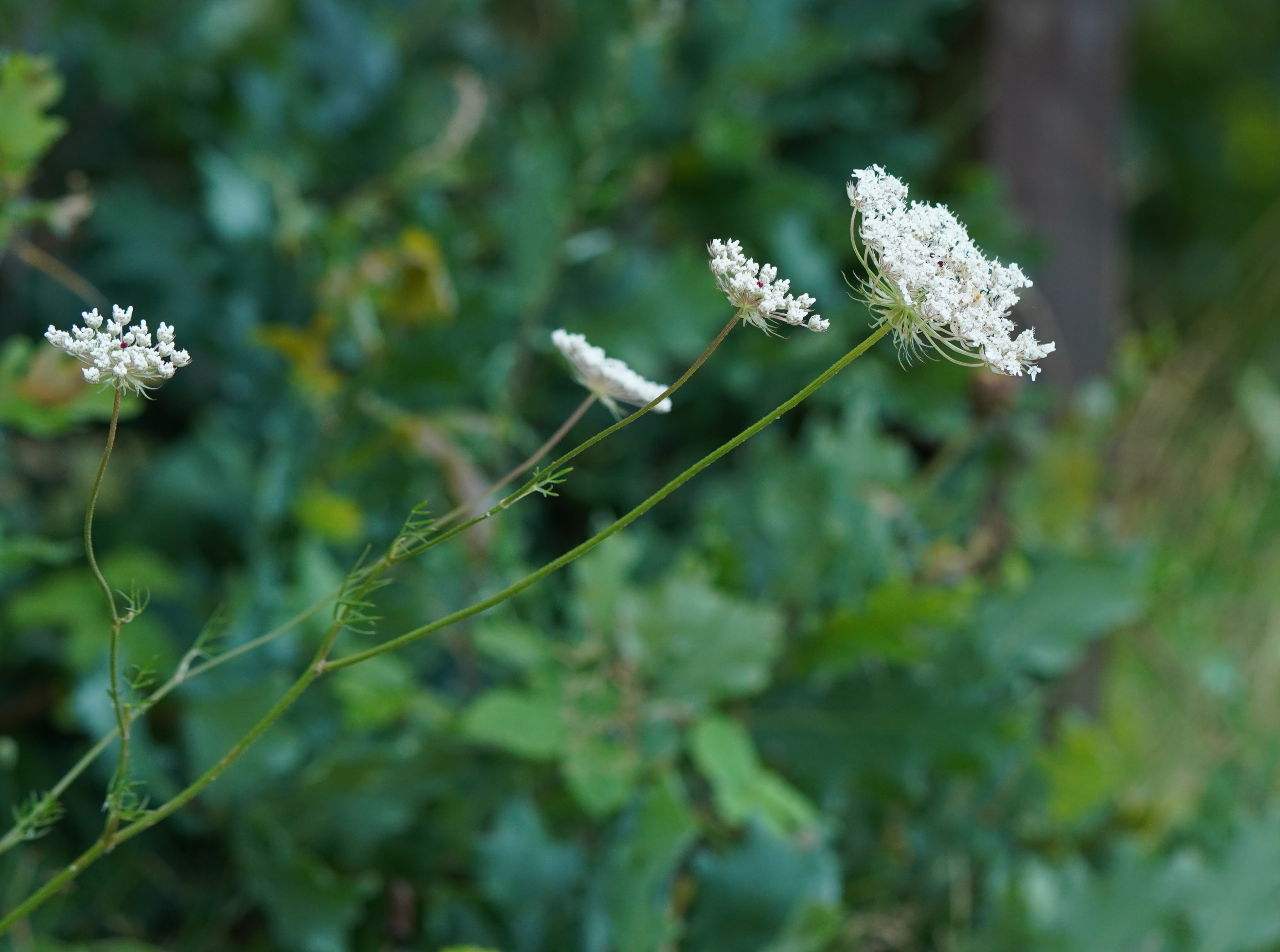
Wild Carrot grows in the car park. This is one of the easier Umbellifers to identify as once the flowers go over, the umbel curls up into a ball.
Wild Carrot Daucus carota [Doghouse practice ground]
Headed out this morning for a walk around the Blue. Was hoping to see some migrant birds, but settled for some interesting flowers instead.
Field Pansies are delicate little flowers - it is well worth topping your drive short left off the 7th to have an excuse to look at them.
Field Pansy Viola arvensis [7th Blue]
Not too far away in the wood there is lots of Wood Sorrell. Just outside is Bugloss - A less spectacular relative of Viper's Bugloss that is common on the courses.
Wood Sorrel Oxalis acetosella [behind 6th Blue]
Bugloss Anchusa arvensis [6th Blue]
There is quite a lot of Cuckoo Flower (also known as Lady's Smock) around the damp areas of the Blue and Green at the moment. This patch was in the rough between the 8th and 11th on the Blue.
Cuckoo Flower Cardamine pratensis [8th Blue]
There is lots of Springbeauty all over the waste areas of the course. It is actually an alien species introduced from North America in 1794. Apparently it is quite good in salads. Look out for the fleshy leaves anywhere that is sandy. This patch was on the 7th Blue.
Springbeauty Claytonia perfoliata [7th Blue]
I managed to find a better specimen of Heath Dog Violet on the 4th of the Green.
Heath Dog Violet Viola canina [4th Blue]
There were a couple of calling Woodpigeons when I got back to the car - they nest in the Leylandii around the chipping area.