Showing posts with label goldfinch. Show all posts

Wednesday, April 15, 2026

5 April 2026


Had a walk around the Blue and red course in the sunshine this morning.  Whilst some of the winter finches are starting to depart the course the resident Goldfinches and Chaffinches are still around. This Goldfinch was between the 4th and 5th on the Red

Goldfinch (5th Red)

There seemed to be a lot more water in the reservoir than I have seen for a while.  There were also a couple of Stock Doves on the shoreline.  They nest near on inside the Greenkeepers hut on the Blue course.

Stock Doves (Reservoir)

There were a lot of birds in the gorse today - whilst much has been cleared, there is still plenty around.  Linnets in particular nest in the gorse - this one was on the 13th of the Blue

Linnet [12th Blue]

It was nice to see a pair of Reed Buntings as well.  These were on the 11th of the Blue.  They usually nest near the pond on the 3rd but are probably looking for a new spot now that the vegetation here has been cleared.  The bird below is a male, with a Dunnock perched nearby.


Tuesday, January 30, 2024

28 January 2024


I went for a walk around the Blue and Red course this morning.  The first time that I have visited in a couple of weeks.  There were a larger numbers of Redwings than I had seen so far this winter, but much smaller numbers than in the previous two years.  There were quite a few finches around, particularly bathing in the ditch on the left of the 3rd Blue - Siskins, Redpolls, Chaffinches and Goldfinches, but again, not in the numbers of previous years.

Redpoll and Goldfinch [3rd Blue]

Waterbirds are enjoying the tranquility of the Blue course.  The Mute Swans seem to move between the 1st and 3rd and a pair of Canada Geese have arrived on the 4th where they usually nest.
Canada Geese [4th Blue]

Mute Swans [1st Blue]


Friday, December 9, 2022

9 December 2022


Had a walk around the Blue and Red courses over the last couple of days.  The weather has been good for photography with lots of sunshine, but freezing cold.  Yesterday was the first time that I have seen a large finch flock on the estate this winter.  There were around 100 birds, moving between the 3rd and 9th on the Blue course.  The flock seemed to consist mostly of Siskins, but with some Goldfinches and Chaffinches mixed in.

Siskin [3rd Blue]

Goldfinch [3rd Blue]

This group of Roe Deer also wandered past as I was watching the Siskins.

Roe Deer [3rd Blue]


I always check out the gulls that I see on the reservoir or on the fairways.  This is usually a tedious and unproductive task, but today I found a single bird that looked slightly different from the norm.  I'm pretty sure that this is a Yellow-legged Gull.  It is a species that is common around the Mediterranean and North Africa, but has expanded range recently.  It is very similar to a Herring Gull.  Its main identifying feature is its yellow legs - Herring Gulls usually have pink legs.  The Yellow-legged Gull used to be considered a sub-species of the Herring Gull, but has recently been separated into a separate species.


Yellow-legged Gull [Reservoir]


Sunday, June 19, 2022

19 June 2022


I had a walk around the reservoir this morning and came across a Redshank stopping by.  It was rather distant, but you can see the orange legs that explain its name.  

Redshank [Reservoir]

Somewhat closer were a few sparrows and finches feeding in the grass and occasionally perching on the barbed wire.
House Sparrow [Reservoir]

Greenfinch [Reservoir]

Goldfinches [Reservoir]

Whilst overhead House Martins, Swifts and a few Swallows were feeding on the flies.

House Martin [Reservoir]

Swift [Reservoir]

In the week I joined the Oxford Flora Group, who were surveying Two Pine Fen.  I discovered that the orchids I had previously identified as Narrow-leaved Marsh Orchid, were actually Common Spotted.  We only managed to find this rather sorry specimen.

Narrow-leaved Marsh Orchid Dactylorhiza traunsteinerioides [16th Red]

Virtually next to this were a couple of Early Marsh Orchids, which to me were pretty much indistinguishable, however, to those more expert have a slightly different flower shape.  I suspect that the orchids that I identified as Southern Marsh on the 9th Red are also Early Marsh.  It emphasised to me that the Dactylorhiza orchids require an expert to separate and are more of a continuum than a set of distinct species.

Early Marsh Orchid Dactylorhiza incarnata [16th Red]


Thursday, March 10, 2022

10 March 2022


I had a quick walk around the front nine of the Blue while it was quiet this morning.  There were lots of finches around again.  The main flock was on the 9th fairway in front of the green, consisting of Chaffinches, Goldfinches, Bramblings and Redpolls.  All of these are on the photo below.

Chaffinches, Goldfinches, Bramblings and Redpoll [9th Blue]


In the trees around there are also lots of Siskins.  I came across this one having a bath in the ditch alongside the 4th.

Siskin [4th Blue]


Sunday, March 6, 2022

6 March 2022


There was a large flock of finches again today, this time feeding on the 1st, 2nd and 9th on the Blue.  These were made up of Chaffinches, Goldfinches and Bramblings.  You can see all three more easily in the photo below - Chaffinches the front two, Goldfinch on the left middle and Bramblings the back right two.


Bramblings, Chaffinches and Goldfinch [1st Blue]

Bramblings are the rarest of the finches around Frilford.  They are distinguishable  by their orange shoulders.  I reckon that there were between 15 and 20 on the fairway and in the trees around.  The one in the middle here is a female:
Brambling [1st Blue]

Bramblings, Chaffinches and Goldfinches [1st Blue]


I saw a Merlin for the second time on the Blue course, high above the trees to the right of the 2nd - scattering the small birds that it was hunting. There were plenty of Wrens, Robins and Blackbirds around the same area.

Wren [1st Blue]

The plant growing on the wall of the car park is Garden Arabis - a garden escape that is often found on old walls close to habitation.

Garden Arabis Arabis caucasica [Car park]


Saturday, August 7, 2021

7 August 2021

Lots of small birds feeding on berries and seeds around the courses at the moment.  The wood around the 13th/16th of the Blue course is particularly productive, with Willow Warblers, Goldcrests, Goldfinches, Blue Tits, Coal Tits, Great Tits, Blackcaps, Treecreepers, Nuthatches, Great-spotted Woodpeckers, Spotted Flycatchers, Robins and Wrens all very easy to see.

Willow Warbler [16th Blue]

Goldcrest [16th Blue]

It is particularly encouraging to see lots of Spotted Flycatchers around the course at the moment.  A pair was hunting for flies in the wood and is the third location on the estate that I have seem a family of Flycatchers.  It is possible that it is the same birds following me around, but more likely that there are two or three groups of birds.

Spotted Flycatchers [16th Blue]

On the reservoir there are a couple of resident families of Tufted Ducks, Coot and Little Grebes with Cormorants and Canada Geese calling in from time to time.

Little Grebe [Reservoir]

There are also lots of birds feeding by the 3rd on the Blue.   This is a juvenile Goldfinch feeding on a Marsh Thistle.  It has the yellow wing bar, but not yet the red face.

Goldfinch [3rd Blue]

Wren [3rd Blue]


Saturday, May 15, 2021

15 May 2021


Went down in between rain showers this afternoon to have a look at the pond on the 3rd Blue.  This is one of the least productive parts of the course for me golf-wise,  but one of the most productive spots wildlife-wise.  Today there were a few different insects around, albeit some more attractive than others.

Orange-tips are attractive butterflies - there were 3 or 4 flying around the pond.  Only the males have orange tips to their wings.  They feed on Cuckoo Flower - such as the one this female has landed on.

Orange-tip [3rd Blue]

Common here and around much of the course are Small Coppers.  They have rather erratic flight and copper-coloured upperwings.

Small Copper [3rd Blue]

Mayflies only live for a day or two after changing from nymph to fly, giving them limited time to find a mate and reproduce, hence their latin name Ephemera. These two at least seem to have succeeded - although I hope that my pointing a large camera at them from 12 inches away didn't spoil their moment.

Mayfly Ephemera vulgata [3rd Blue]

Following a similar life cycle are Alder Flies, whose nymphs also live at the bottom of ponds and live as adults only for a few days.

Alder Fly Sialis lutaria [3rd Blue]

There were quite a lot of these shiny purple beetles.  There are around 4000 species of beetle in the UK.  I haven't checked them all, but I think that these are Alder Leaf Beetles.

Alder Leaf Beetle Agelastica alni [3rd Blue]

The birds were enjoying this insect emergence.  A pair of Reed Bunting nest on the far side of the pond and were picking off the slow-flying Mayflies.

A Kingfisher was also showing well, hovering over the pond at one point.  This seems to be the best spot on the courses to see them at the moment.
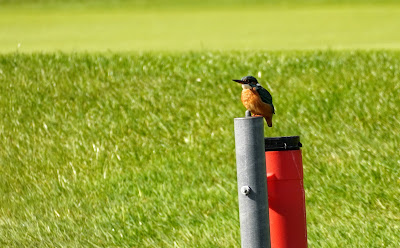
Kingfisher [3rd Blue]

Goldfinches were collecting nesting material on the margins of the pond.  This one looks in need of a shave.

Goldfinch [3rd Blue]

One of the characteristic plants of this hole is Common Comfrey, which grows along the stream and in the fen.  This one was growing on the bank behind the pond.

Common Comfrey  Symphytum officinale [3rd Blue]