Showing posts with label Orange-tip. Show all posts

Monday, May 2, 2022

30 April 2022

The sunshine meant that butterflies were out in good numbers today.  One of the most noticeable at this time of year is the Orange Tip.  The male is easy to identify with orange patches at the end of its wing.  The female is less obvious. 

Orange Tip Anthocharis cardamines  [Tubney range]

I saw lots of other butterflies about today including Brimstones, Peacocks, Speckled Wood and Holly Blue.

Speckled Wood Pararge aegeria [6th Blue]
Holly Blue Celastrina argiolus [14th Red]

Several Whitethroats were singing on the Doghouse range.  This Whitethroat was singing in the same spot as last weekend.  
Whitethroat [Doghouse range]

Subterraneum clover is one of the specialist species of Frilford.  You can see it on the Doghouse range and on the short rough on the Green course. It is very abundant, but tiny - in this photo I have included a tee for scale.

Subterranean Clover Trifolium subterraneum [Doghouse range]

Another rarity is Heath Dog Violet which is a bit smaller than Common Dog Violet and has a yellow spur.  You can find this between the 7th and 10th on the Gree course and on the footpath alongside the 4th on the Red.

Heath Dog Violet [4th Red]


Saturday, June 5, 2021

5 June 2021


Very hot and sunny today - everything looking very lush and green.  

On the Doghouse range I managed to find another of the rare Frilford plants - Hoary Cinquefoil.  This is another Potentilla and can be identified by the downy white hairs on the back of the leaves and stem.  I found it on the left of the range near the car park.

Hoary Cinquefoil Potentilla argentia [Doghouse range]

Easier to spot, the Lupins on the Doghouse range are quite spectacular at the moment.

Tree Lupin Lupinus arboreus [Doghouse range]

There are a couple of species of Sandwort around the course at the moment, these are rather inconspicuous white flowers.  Thyme-leaved Sandwort grows to the right of the 15th Red and the much larger Three-nerved Sandwort grows in a few places, including the wood behind the 6th Blue and on the left of the 13th Red.

Thyme-leaved Sandwort Arenaria serpyllifolia [ 15th Red]

Three-nerved Sandwort Moehringia trinvervia [6th Blue]

Lesser Stitchwort is fairly common and can be found growing in the rough in various places around the course.

Lesser Stitchwort Stellaria graminea [13th Red]

The next batch of orchids are starting to flower in the damp areas.  Common Spotted Orchids are the most frequent around the courses.  

Common Spotted Orchid Dactylorhiza fuchsii [16th Red]

Yellow Irises are also starting to show, particularly around the pond by the 4th tee on the Blue.

Yellow Iris Iris pseudacorus [4th Blue]

Also plenty of insects about at the moment.  This Beautiful Demoiselle was on the 4th Blue

Beautiful Demoiselle Calopteryx virgo [4th Blue]

Orange-tip Anthocharis cardamines [Doghouse range]

Small Copper Lycaena phlaeas [15th Red]

Fairly quiet bird-wise.  Most seem more focused on feeding their broods than posing for photos, but there are quite a few noisy woodpeckers around.

Great-spotted Woodpecker [2nd Blue]


Saturday, May 15, 2021

15 May 2021


Went down in between rain showers this afternoon to have a look at the pond on the 3rd Blue.  This is one of the least productive parts of the course for me golf-wise,  but one of the most productive spots wildlife-wise.  Today there were a few different insects around, albeit some more attractive than others.

Orange-tips are attractive butterflies - there were 3 or 4 flying around the pond.  Only the males have orange tips to their wings.  They feed on Cuckoo Flower - such as the one this female has landed on.

Orange-tip [3rd Blue]

Common here and around much of the course are Small Coppers.  They have rather erratic flight and copper-coloured upperwings.

Small Copper [3rd Blue]

Mayflies only live for a day or two after changing from nymph to fly, giving them limited time to find a mate and reproduce, hence their latin name Ephemera. These two at least seem to have succeeded - although I hope that my pointing a large camera at them from 12 inches away didn't spoil their moment.

Mayfly Ephemera vulgata [3rd Blue]

Following a similar life cycle are Alder Flies, whose nymphs also live at the bottom of ponds and live as adults only for a few days.

Alder Fly Sialis lutaria [3rd Blue]

There were quite a lot of these shiny purple beetles.  There are around 4000 species of beetle in the UK.  I haven't checked them all, but I think that these are Alder Leaf Beetles.

Alder Leaf Beetle Agelastica alni [3rd Blue]

The birds were enjoying this insect emergence.  A pair of Reed Bunting nest on the far side of the pond and were picking off the slow-flying Mayflies.

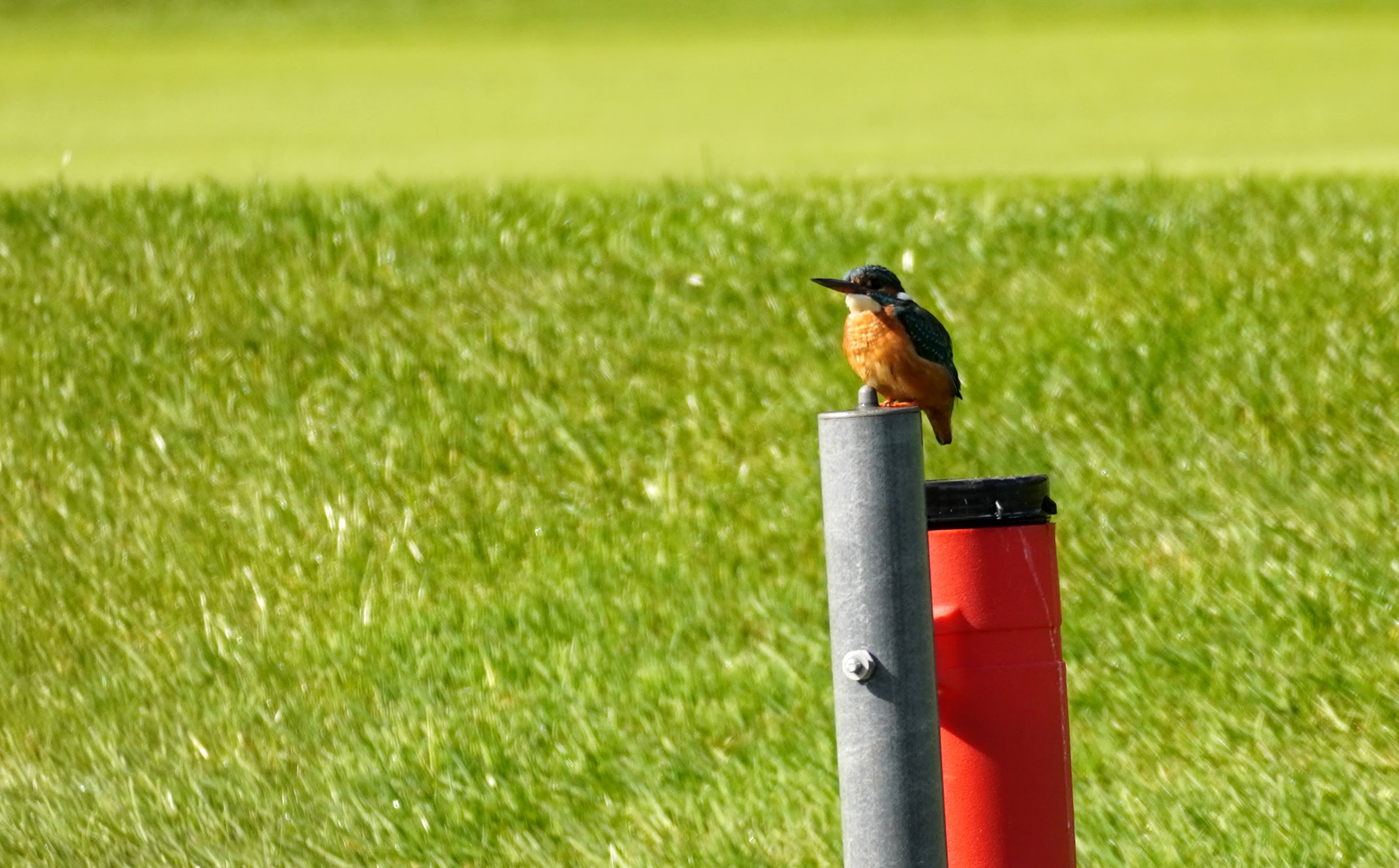
A Kingfisher was also showing well, hovering over the pond at one point.  This seems to be the best spot on the courses to see them at the moment.

Kingfisher [3rd Blue]

Goldfinches were collecting nesting material on the margins of the pond.  This one looks in need of a shave.

Goldfinch [3rd Blue]

One of the characteristic plants of this hole is Common Comfrey, which grows along the stream and in the fen.  This one was growing on the bank behind the pond.

Common Comfrey  Symphytum officinale [3rd Blue]


Saturday, May 1, 2021

1 May 2021


 Lots of birds around the course today.  I had a long walk around the Blue and Red.  

There are still Crossbills around the Blue in particular.  I quite often see them in the mornings preening on the large willow tree to the left of the 5th.  Today there were 15 or so perched in the sunlight and dropping down to the stream to drink.

Crossbills [5th Blue]

The last two days are the first time that I've seen Whitethroats this year and there are suddenly lots of them.  I've seen or heard them on the 3rd Blue, 7th Blue, 15th Red and this one of a pair to the left of the 4th Red.

Whitethroat [4th Red]

They are scrub warblers that favour small bushes.  They can be difficult to separate from Lesser Whitethroats, but the brown wings are characteristic.   Lesser Whitethroats  have uniform slate grey upper-parts as you can see from the photo that I took by the 2nd Blue last weekend.  Whitethroats are also a bit larger with a proportionally larger head and light coloured legs.  Whitethroats tend to sing from a perch out in the open whereas Lesser Whitethroats are shyer.

Lesser Whitethroat [2nd Blue]

Bluebells are in full bloom around the course at the moment.  If you look closely there are actually two species, the native Bluebell and the introduced Spanish Bluebell.  Spanish Bluebells have shorter broader flowers that are slightly lighter and appear two-tone.  Native Bluebells have narrow flowers and the tips of the petals curve right back.  The two grow side by side at the back of the 18th green on the Green. They also hybridise readily and come in whites and pinks as well as blue.

Bluebell Hyacinthoides non-scripta [18th Green]

Spanish Bluebell Hyacinthoides hispanica [6th Red]

There were a lot of other birds around.  I had good views of a Peregrine on the 5th Blue and Kingfisher on 3rd Blue, but was not quick enough to get a photo.  I had some more success with the following:

Jay [1st Green]

Stock Doves [16th Blue]

Pheasant [6th Blue]

Lots more butterflies about.  This Orange tip landed on the fairway on the 13th Blue - only the males have orange tips to their wings.

Orange Tip [13th Blue]