Saturday, June 19, 2021

19 June 2021

Lots of new yellow flowers on the course at the moment.  Many of these are compositae - i.e. in the daisy family and add to the rather bewildering array of dandelion lookalikes on the courses.  

In front of the 4th Green Blue is Rough Hawkbit with a rather untidy array of petals and hairy stalk.

Rough Hawkbit Leontodon hispidus [4th Green]

Better presented and less hirsute is Lesser Hawkbit which grows on the Doghouse range and on the Green course.

Lesser Hawkbit Leontodon saxatillis [Doghouse Range]

Taller with smaller flowers is Nipplewort.  This one growing between the 2nd and 9th on the Blue.

Nipplewort Lapsana communis [2nd Blue]

Fairly common in the rough on all of the courses is Smooth Hawksbeard with branched stems and small flower heads that contract onto a slender stem.

Smooth Hawksbeard Crepis capillaris [Doghouse range]

Somewhat larger, with spreading outer bracts, Beaked Hawksbeard is also quite common on the courses.

Beaked Hawksbeard Crepis visicaria [11th Blue]

Prickly Sowthistle has lots of spines on its leaves.  This one was by the 15th tee on the Blue.

Prickly Sowthistle Sonchus asper [15th Blue]

Rather less prickly is Smooth Sowthistle.

Smooth Sowthistle Sonchus oleraceus [3rd Blue]

Common Groundsel is abundant all over the estate, on almost any waste area.  Heath Groundsel is a little more discerning.  I found a patch of this on top of one of the bunkers on the 9th Green.

Heath Groundsel Senecio sylvaticus [9th Green]

Common Cudweed is a plant that mostly grows in East Anglia and is on Oxfordshire's rare plants register.  Like several of Frilford's rare plants it is common on the estate and grows quite prolifically on various parts of all three courses - look out for its silvery leaves and small, odd-looking flower heads.

Common Cudweed Filago vulgaris [Doghouse range]

Thursday, June 17, 2021

17 June 2021

 First day for a while that it has not been bright sunshine first thing.  On a quick walk around the Green course I came across this Common Broomrape.  It is one of the few UK flowering plants without chlorophyll that provides most plants with green colouration.  It does not require this as it is non-photosynthetic and gets its nutrients from a host plant on which it is a parasite - typically these are members of the pea family such as Gorse or Broom.  This one was growing to the left of the 7th.

Common Broomrape Orobanche minor [7th Green]

Yarrow is abundant in the rough on all of the courses.  It is a member of the daisy family with an umbrella of flowers.

Yarrow Achillea millefolium [9th Green]

In the ditch between the 9th and 13th I came across Brookweed, a small white flower that usually grows by the sea and is on Oxfordshire's rare plant register

Brookweed Samolus valerandi [11th Green]

On the 1st of the red I managed to identify another clover.  This one is Alsike Clover - which is a common feed plant.  It is very similar to White Clover, but is more pinkish in colour, lacks the chevrons on the leaves and has pointed stipules.  There was some white clover close by for comparison.

Alsike Clover Trifolium hybridum [1st Red]

White Clover Trifolium repens [1st Red]

The Cormorant was moving between the ponds on the blue this morning emptying fish stocks.  I also came across this female Mallard with her brood of ducklings.

Cormorant [3rd Blue]

Mallards [1st Blue]

I also saw a Barn Owl this morning fly out from the next box besides the 3rd on the Blue - the first that I have seen on the course for a couple of years.  


Wednesday, June 16, 2021

16 June 2021

I was surprised to come across a Cormorant on the pond on the 3rd Blue early this morning.  I've see them flying over quite regularly but have not seen one stop by.  It was finding plenty to eat, catching 4 or 5 fish in the five minutes that I watched it.

Cormorant [3rd Blue]

There is lots of Hare's-foot Clover in the rough around the 11th on the Blue and also on the first red, growing among the Sheep's Sorrel

Hare's-foot Clover Trifolium arvense [1st Red]

A couple more plants in flower.  

Common Mallow Malva sylvestris [17th Blue]

Woody Nightshade Solanum dulcamara [4th Red]

This Scarlet Tiger moth was on the 9th Red.

Scarlet Tiger Callimorpha dominula [9th Red]

As you would expect - while visiting the more remote parts of the courses I come across quite a few golf balls - in all sorts of places.  One of the most common species is the Titleist ProV1 - these are predominantly white, but occasionally you may come across a yellow one.  I found this one nestling in the rough to the left of the 17th fairway.

Titleist ProV1 (yellow) [17th Blue]


Tuesday, June 15, 2021

15 June 2021

Played the front nine of the Red this evening.  I've not noticed the large patch of Marsh Orchids short of the pond on the 9th before - to be fair my tee shot does usually carry them.  These look like Southern Marsh (with a few Common Spotted mixed in - you can see a couple in the top left).

Southern Marsh Orchids Dactylorhiza praetermissa [9th Red]

The Southern Marsh Orchids are not as large as the ones on the 11th Blue, but you can distinguish them from the Common Spotted as they are generally darker purple - but more reliably by the shape of the flower.  Common Spotted Orchids have three distinct parts to the lower lobe, fairly evenly proportioned, whereas Southern Marsh tend to have more of a one-part lower lobe.  Pyramidal Orchids have 3 evenly proportioned parts to the lower lobe without patterns on the flowers.

Common Spotted

Southern Marsh

Pyramidal

Away from Orchids I found a Hedge Woundwort in a couple of places - this one beside the path on the 4th Green.

Hedge Woundwort Stachys sylvatica [4th Green]


Monday, June 14, 2021

14 June 2021

Had a quick walk around some of the Blue this morning in the sunshine and played on the Green this evening.

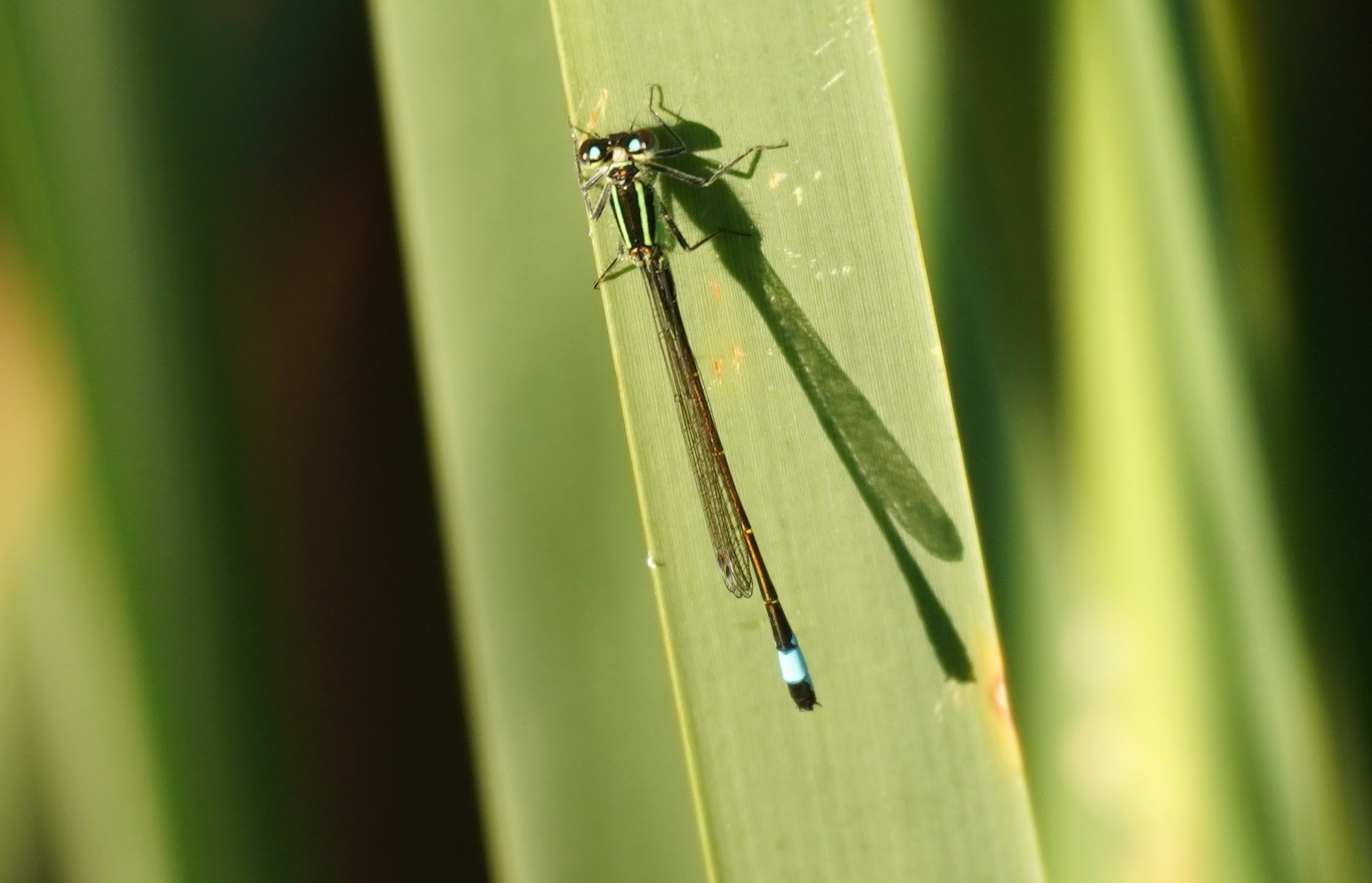
Came across a new species of damselfly on the pond in front of the 4th tee.  There were quite of few of them flying round.

Blue-tailed Damselfly (male) Ischnura elegans [4th Blue]

Both Dog Rose and Honeysuckle are scrambling across the Hedgerow to the left of the 2nd.

Dog Rose Rosa canina [2nd Blue]

Honeysuckle Lonicera periclymenum [2nd Blue]

I found another Pyramidal Orchid between the 8th and 11th, this time fully in flower, not far from the Southern Marsh Orchids (first photo).

Pyramidal Orchid Anacamptis pyramidalis [10th Blue]

In amongst the thick rough there are a few different species of thistle - providing extra incentive to keep the ball on the fairway, particularly if wearing shorts or a skirt.  Musk thistle is the one that has large nodding flower heads.

Musk Thistle Carduus nutans [12th Blue]

Welted thistle has smaller flowers and branched stems and lots of spiny wings all the way up the stem.

Welted Thistle Carduus crispus [15th Blue]

Marsh thistle has unbranched stems and a cluster of flowers at the top.

Marsh Thistle Cirsium palustre [4th Green]

Meadow Thistle is friendlier and has no harsh spines and a single flower on a long stalk.  You can see this growing in the fen around the 4th Green/16th Red.

Meadow Thistle Cirsium dissectum [16th Red]


13 June 2021


Two of the rarest plants on the course are Maiden Pink and the Narrow-leaved Marsh Orchid.  The Maiden Pink is easy to spot and identify, not least because it has orange tape around it at the moment.  It is well worth having a quick look from the 10th tee on the Green whilst you debate whether or not to try to drive the green.  There are a couple of the small vibrant pink flowers out at the moment.  Hopefully more will appear as the season progresses.


Maiden Pink Dianthus deltoides [10th Green]

The Narrow-leaved Marsh Orchid is much harder to find amongst the Common Spotted Orchids on the 4th of the Green.  I understand that it appears in small numbers most years and that there is actually some debate as to whether this identification is correct - Orchids are notoriously difficult to identify as they hybridise so readily.  I found the orchid below in the right location on the 4th to the left of the green and it looks to have a different shaped lip and looser flowers than the Common Spotted Orchids, but it requires verification by an expert to confirm whether it is Narrow-leaved Marsh.

Narrow-leaved Marsh Orchid Dactylorhiza traunsteineri??? [4th Green]

Elsewhere on the course, the tall spikes of Viper's Bugloss and Foxgloves are in flower now.

Vipers Buglos Echium vulgare [15th Red]

Foxgloves Digitalis purpurea [15th Red]

Other new plants include:

Small Balsam Impatiens parviflora [12th Red]

Ground Elder Aegopodium podagraria [13th Red]

Fox-and-cubs Pilosella aurantiaca [15th Blue]

Saturday, June 12, 2021

12 June 2021

Baking hot day today.  Lots of dragonflies around today - I was able to spot 5 species:

Beautiful Demoiselle - The ones with dark wings that are common on the first few holes of Blue.

Azure Damselfly - Small blue Damselfly.  Lots around the water on the Blue.

Black-tailed Skimmer - The males have a blue body and the females are brown.  These are common in the area to the left of the 15th Red.

Emporer Dragonfly - Britain's bulkiest Dragonfly, with a blue and green body.  On the pond to the left of the 4th Blue and in the rough on the Red.

Four-spotted Chaser - Brown Dragonfly with spots on its wings - lots of them around the pond on the 4th Blue.

Black-tailed Skimmer (male) Orthetrum cancellatum [15th Red]

Black-tailed Skimmer (female) Orthetrum cancellatum [15th Red]

Emperor Dragonfly Anax imperator [15th Red]

Four spotted Chaser Libellula quadrimaculata [4th Blue]

Azure Damselfly Coenagrion puella [1st Blue]

Beautiful Demoiselle (male) Calopteryx virgo [1st Blue]

I visited the water a couple of times on the first few holes of the Blue, allowing me to spot some new flowers for the year:

White Waterlily Nymphaea alba [1st Blue]

Water Forget-me-not Myosotit scorpioides [1st Blue]

Celery-leaved Buttercup Ranunculus sceleratus [1st Blue]

Brooklime Veronica Beccabunga [4th Blue]

A group of baby warblers, this time Blackcaps - to the left of the 13th Red. Here is one of them..

Blackcap [13th Red]

There were a couple of Kestrels hunting over the 9th Blue.

Kestrel [9th Blue]

On the 15th Red was another black and crimson day-flying moth, the Cinnabar.

Cinnabar Tyria Jacobaeae [15th Red]